


The most expensive sales orders in any JDE installation are the ones that should never have made it into F4211 in the first place. A 1,200-unit order against an item with a maximum order quantity of 200. A shipment to a customer whose credit limit was breached three orders ago. A line item with a promised date that falls before today. These are not exotic edge cases — they happen every week on every system that does not have proper custom order entry validation in JD Edwards EnterpriseOne using BSFN logic, and they end up as credit memos, expedited freight charges, or warehouse pick errors that nobody traces back to the original entry.
The standard P4210 application catches a handful of these through Form Event Rules and data dictionary checks, but the moment the order comes in through an orchestration, an AIS service, or a Z-file import, those client-side rules are bypassed entirely. The validation has to live where every entry path eventually arrives: in a compiled business function that runs server-side, before any row touches F4211.
Why client-side validation alone always fails eventually
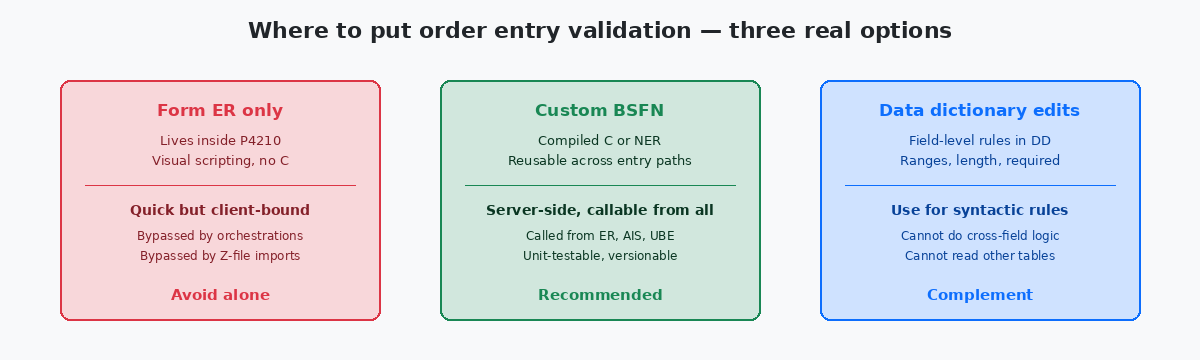
Form Event Rules inside P4210Sales Order Entry — the standard JDE application used to create and revise sales orders. Its grid form and detail form host the order header and line items respectively. are the natural first place to put a validation rule. They are visual, fast to write, and they fire at the right moment when a user is keying an order through the standard form. The problem is not what they do; the problem is everything they do not see.
An order placed through an Orchestrator flow calls the underlying AIS endpoint, which writes directly to the F4211 table through the data layer. Form ER does not execute. An order created by an EDI inbound process flows through the Z-file table F47011 and into F4211 via R47011 — again, Form ER never runs. A B2B integration that posts orders through the REST API hits the same data layer, and the same client-side rules are bypassed.
On a typical mid-sized installation, the share of sales orders coming through these non-form channels is somewhere between 30% and 60%, and growing every year as Orchestrator and AIS adoption increases. Validation that only fires in the green-screen path is validation that protects a shrinking minority of orders.
The pattern that solves this is straightforward to state and routinely fumbled in practice: the validation logic lives in a business function, and every entry path — including the standard form — calls it. Form ER becomes a thin wrapper that calls the BSFN and reacts to the error code returned. The data dictionary stays in charge of single-field syntactic rules (length, range, required). Everything cross-field, cross-table, or condition-dependent moves into the BSFN.
The anatomy of a custom validation BSFN
A validation BSFN has three jobs: read the inputs from the data structure, run the rules, and write outputs back into the same structure for the caller to read. The signature is the contract every entry path will rely on, and getting it right at the start saves an enormous amount of refactoring later. The pattern that ages well is one BSFN per validation domain — credit, inventory availability, pricing eligibility — rather than one mega-function that tries to do everything.
Inside the function, the rules execute in fail-fast order: cheapest check first, most expensive last. A null branch/plant check costs nothing and rules out a class of failures before any database read. A check against the customer master F0301 to read credit status costs one table fetch. A check that aggregates open order amounts from F4211 to compute exposure costs a range read with an index on AN8 and OPSTS. Order the rules by cost and the average execution stays fast even when most calls return clean.
The output pattern that integrates cleanly with both Form ER and AIS callers is a structured error result: a single character error severity (E for error, W for warning), an error code that maps to a row in F7900Error Message File — the JDE table that holds error message text keyed by error code. Adding custom codes here lets every caller display consistent multi-language messages without hardcoding text., and an optional error parameter string. Form ER reads the severity and either highlights the row or blocks the save. An AIS caller reads the same fields and returns them in the JSON response. The same BSFN, the same error semantics, two completely different user experiences.
Choosing between C and NER for the implementation
JDE gives you two ways to write a custom business function: compiled C through Business Function Design Aid, or NERNamed Event Rules — the visual scripting language used to write business functions without writing C code. Compiled to C under the hood by the Tools Release, but written and maintained as Event Rules. through the visual designer. The choice is not religious, and the right answer depends on what the function actually does.
NER is the right choice for validations that are mostly table reads, conditional branches, and error code assignments. It compiles to the same object format as C BSFNs, it runs at comparable speed, and it is dramatically easier to maintain by the next person who has to touch it. A senior consultant can read an NER in fifteen minutes and understand it; the same code in C takes forty-five and assumes the reader knows the JDE C macros for jdeStrcpy, jdeERRORInsert, and the data structure access patterns.
C is the right choice when the function does string parsing, complex date arithmetic that NER's event rule operators do not handle cleanly, or when it has to call third-party libraries linked into the JDE runtime. For order entry validation, that situation almost never arises. Of the last fifteen validation BSFNs I have written or reviewed, fourteen were NER and one was C, and the one C function was C only because it shared a header file with an existing legacy module.
One discipline that does not change between C and NER: the function must be re-entrant. JDE will call it from multiple threads in parallel under load, and any module-level state will produce intermittent bugs that take weeks to diagnose. State lives in the data structure passed in, never in static variables.
Wiring the BSFN into every entry path
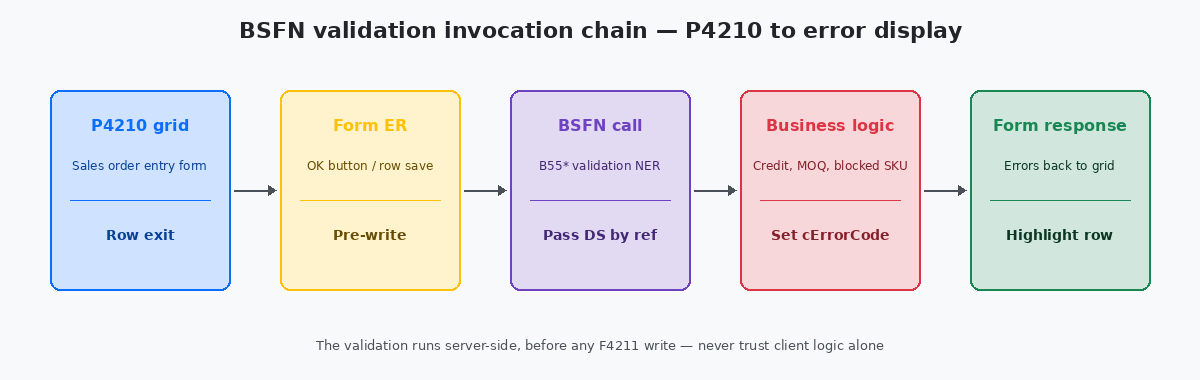
Once the function exists, the integration work is what makes it actually useful. In P4210, the call goes in the row-save Form ER, immediately before the line is committed. The error code returned is checked, and if severity is E the save is blocked and the offending row is highlighted; if W, the user gets a confirmation dialog. This is twenty lines of Form ER and it preserves the standard form's user experience while routing every save through the central rule set.
For Orchestrator and AIS callers, the same BSFN is invoked through the Form Service Request or through a dedicated orchestration step that calls the function directly. The output data structure flows back into the orchestration response, and the calling system — whether that is a B2B partner's ERP, a customer portal, or a mobile app — receives a structured error payload it can render to its own users. This pattern is what makes the validation truly universal rather than form-bound.
For Z-file imports through R47011, the BSFN is called inside the UBE's processing loop, after the inbound row is read and before the standard F4211 insertion logic runs. Rows that fail validation are flagged in the Z-file with an error code and excluded from the insert, leaving a clear audit trail of what was rejected and why. The R47011 standard processing already supports this pattern through its error handling section — the custom BSFN simply plugs in.
The discipline that holds the whole thing together is having one and only one entry point in the codebase that defines what "a valid sales order line" means. When the business changes the rule for minimum order quantity on hazmat items, the change goes in one BSFN, gets tested once, gets promoted through the standard environments, and takes effect across every channel simultaneously. The alternative — three places to update, three separate test cycles, three opportunities to forget one — is what produces the support tickets nobody wants.
Testing and promoting a custom validation BSFN safely
A validation BSFN sits on a critical write path, which means any regression has direct revenue impact. The testing discipline that has saved me more than once is unit-style isolation: a small custom UBE that builds the input data structure programmatically, calls the BSFN, and asserts the expected error code and severity for each case. Twenty to thirty test cases per BSFN covers credit limits, MOQ rules, blocked SKUs, date validation, and the cross-table conditions that defy manual testing. The test UBE lives in the same package as the BSFN itself and gets promoted with it.
Promotion through DV, PY, and PD environments follows the standard OMW path, but with one addition specific to validation functions: the promoted BSFN should not become active in PD on the day of the promotion. Wrap the new rule logic in a feature flag read from a UDC table, deploy with the flag set to inactive, verify in PD that the function is callable and that the old behaviour is unchanged, then flip the flag during a quiet window. A bad validation rule that fires immediately on promotion can block every order entry across the business for as long as it takes to back out — feature-flagging is twenty extra lines of ER and a few hours of process discipline, and it converts a potential outage into a non-event.
For more on this side of JDE development, the related articles on retrofitting copies of standard, on NER versus C decision patterns, and on BSFN testing harnesses go deeper into each piece touched on here. The technical project portfolio on this site documents two production validation suites that produced the patterns above.