Select your language


- Details
-
 By Vincenzo Caserta
 - Category: BSFN NER Development
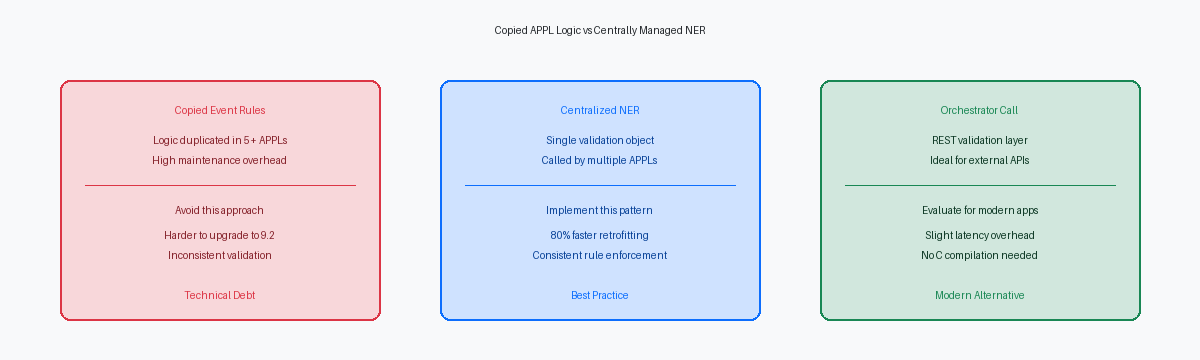
When auditing custom object repositories for 9.1 to 9.2 upgrades, I routinely find that a significant portion of custom validation logic—often between 30% and 50%—is duplicated across interactive applications like P4210 and P4310. Developers copy-paste Event Rules (ER)JD Edwards' proprietary scripting language used to define business logic within applications and reports. to meet tight deadlines, turning a simple validation rule into a maintenance bottleneck that breaks during Tools ReleaseThe foundational technology layer of JD Edwards that manages system performance, security, and web interactions. updates or when applying ESUsElectronic Software Updates are individual software patches released by Oracle to fix specific issues or provide enhancements.. This architectural anti-pattern unnecessarily inflates your custom code footprint and drives up retrofitting costs during upgrade cycles. To eliminate this technical debt, developers must transition to a centralized architecture; this JDE NER development example of reusable event rules for business logic demonstrates how to isolate validation rules inside a single Named Event Rule (N55XXXXX)A reusable business function created using Event Rules that can be called by various JDE objects. rather than scattering them across APPL events. Wrapping this logic in an NER generates a clean C business function (BSFN)Modular units of code, written in C or Event Rules, that execute specific business tasks. that can be called by P4210, P4312, or even an AIS orchestrationAutomated workflows using the Application Interface Services to allow external systems to interact with JD Edwards., reducing your upgrade retrofit timeline from weeks to hours.
- Details
- By Vincenzo Caserta
- Category: BSFN NER Development
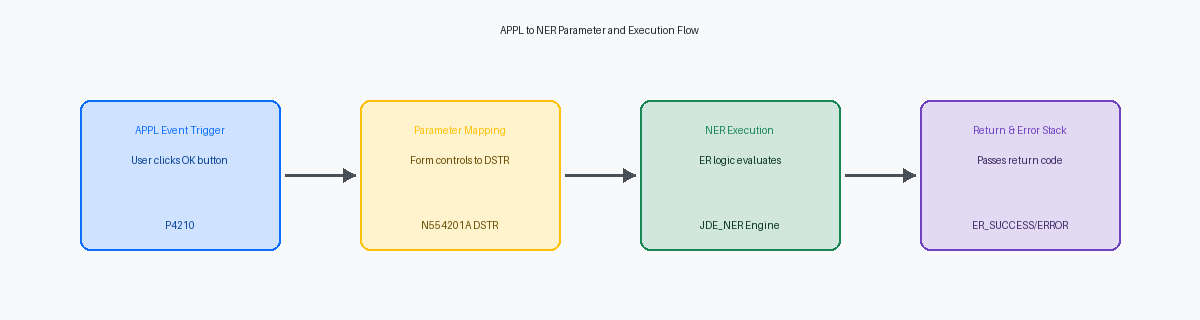
Spinning up a C debugger like Microsoft Visual Studio to step through a Named Event Rule (NER) is often unnecessary and time-consuming. For most JD Edwards developers, a more efficient approach to JDE NER debugging involves tracing event rules triggered directly from an application call using the runtime engine's native logging capabilities. By systematically analyzing the call stack, parameter mappings, and return codes within the local debug log, you can rapidly isolate the root cause of transactional failures without the overhead of compiling debug symbols or attaching external processes.
- Details
- By Vincenzo Caserta
- Category: BSFN NER Development
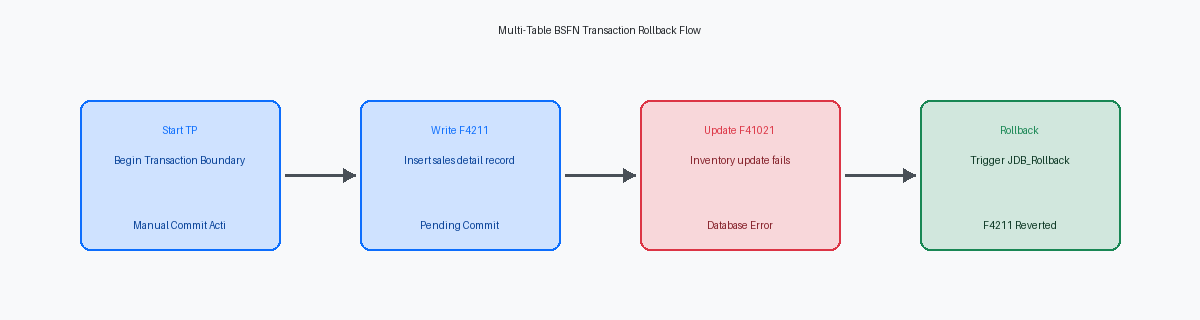
In high-volume distribution environments, implementing a JDE BSFNBusiness Function: A reusable piece of code in JD Edwards that performs specific logic or database operations. transaction boundaryThe start and end points of a database transaction, ensuring all operations within it succeed or fail as a single unit. example to avoid partial updates is critical; a single orphaned F4211The Sales Order Detail table in JD Edwards, storing line-item information for sales orders. record without a corresponding F41021The Item Location table, which tracks inventory quantities and commitments at specific warehouse locations. commitment adjustment can halt an entire warehouse's shipping run. When custom C BSFNs or NERs perform multi-table writes, developers often assume that checking the "Transaction Processing" checkbox on the APPL or UBEUniversal Batch Engine: The JD Edwards tool used to create and run background reports and batch processing jobs. properties is enough to inherit the boundary. It is not. Without explicit boundary propagation down to the master business function (MBF)A specialized business function designed to centralize and standardize complex database updates for core entities like orders. level, a database timeout or a standard jdeCallBf failure mid-stream will commit the header but roll back the detail, leaving you with corrupted ledger states.

- Details
- By Vincenzo Caserta
- Category: BSFN NER Development
Standard Event Rules (ER)JD Edwards Event Rules, a visual scripting language used to create logic within applications and reports without writing raw C code. Table I/ODatabase Input/Output operations used to read, write, update, or delete records within database tables. is sufficient for low-volume interactive applications, but it fails under high-concurrency workloads. When you have 50 to 100 concurrent threads from rapid-fire AIS OrchestratorA JD Edwards tool used to create and manage automated integrations and complex business processes via REST services. calls or multi-threaded UBEsUniversal Batch Engines, which are background processes in JD Edwards used for running reports and high-volume data processing. hitting the same custom F55 tables, ER's lack of explicit record-locking control leads to dirty reads and primary key violations. To prevent data corruption, developers must move beyond basic ER and implement a strict C-based JDE BSFNBusiness Function, a reusable piece of logic written in C or Event Rules that performs specific business tasks in JD Edwards. table IO pattern to read and update custom tables safely.

- Details
- By Vincenzo Caserta
- Category: BSFN NER Development
A single misaligned byte in a BSFNBusiness Function: A reusable piece of logic written in C or Named Event Rules used in JD Edwards. DSTRData Structure: A collection of parameters used to pass data between JD Edwards objects and business functions. can crash a CallObject KernelA server process in JD Edwards responsible for executing business functions on the Enterprise Server. on your Enterprise ServerThe central server in a JD Edwards architecture that handles logic execution and database communication., dropping dozens of active user sessions instantly. Developers often treat these structures like standard database schemas, assuming they can append a field or reorder parameters without consequence. In reality, the JDE runtime engine relies on strict single-byte structure alignment in C. Mastering JDE BSFN specifications—specifically how to read parameters and data structures—is the thin line between a stable system upgrade and a series of catastrophic memory violations at runtime.
More Articles …
Page 2 of 6