Select your language


- Details
-
 By Vincenzo Caserta
 - Category: UBE Development
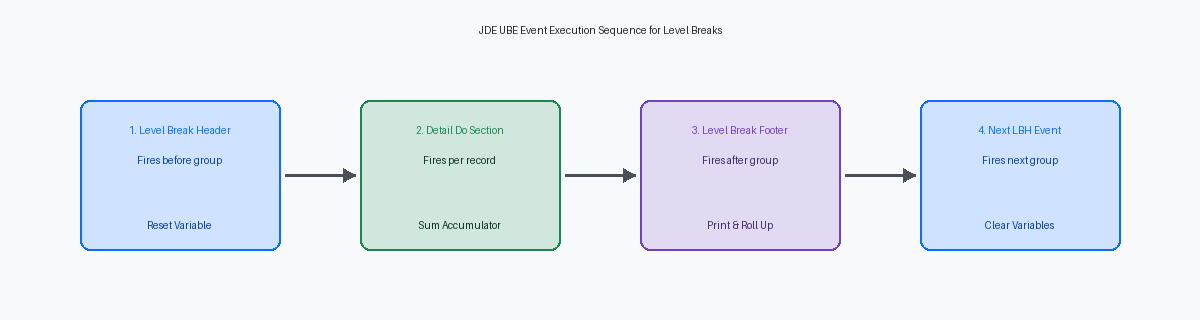
A clean Event Rules (ER)The proprietary scripting language used in JD Edwards to define business logic and event-driven processing. compile in Report Design AssistantThe JD Edwards tool used to design, configure, and modify batch reports and processes. guarantees syntax validity, but it tells you nothing about mathematical integrity. On mature 9.2 buildsSoftware releases running on JD Edwards EnterpriseOne version 9.2. running batch processes over 100,000 ledger or inventory rows, misplaced variable reset timing never triggers a runtime error or a C-BSFNA C-language Business Function in JD Edwards used to perform complex calculations or database operations. memory violation. Instead, the UBEUniversal Batch Engine, the JD Edwards background processing engine used to run reports and batch jobs. completes with a Status 60A JD Edwards job status indicating that a batch process has completed successfully. while quietly generating off-by-one sub-totals or double-counted grand totals across section boundaries.

- Details
- By Vincenzo Caserta
- Category: UBE Development
In enterprise JDEJD Edwards, an enterprise resource planning (ERP) software suite from Oracle. environments where core ledger tables like F0911The JD Edwards General Ledger Detail table that stores all financial transaction records. or transaction ledgers like F4111The JD Edwards Item Ledger table that tracks inventory transactions and history. scale past 20 million rows, a single poorly structured RDAReport Design Aid, the JD Edwards tool used to design and modify reports and batch processes. clause can degrade a sub-minute batch run into a multi-hour queue bottleneck. When overnight batch windows blow out, infrastructure teams usually blame CNCConfigurable Network Computing, the technical architecture and system administration methodology of JD Edwards. queue allocations or demand database memory upgrades. In reality, a substantial majority of long-running custom UBEsUniversal Batch Engine, a JD Edwards background process or report that runs batch jobs.—often three-quarters or more—stem directly from inefficient SQLStructured Query Language, the standard programming language used to manage and query relational databases. generated by flawed selection criteria.

- Details
- By Vincenzo Caserta
- Category: UBE Development
When finance or supply chain teams demand daily automated reconciliation between standard ledger tables like the F0911The standard JD Edwards General Ledger table that stores detailed financial transaction records. and third-party systems, database administrators often reflexively write external SQL scripts or database triggers. That approach regularly backfires: it bypasses JDE Object Management Workbench (OMWObject Management Workbench, the JD Edwards toolset used to manage the development lifecycle and transfer of software objects.) lifecycle controls, ignores security rules, and risks table-locking active transaction tables during peak batch windows.

- Details
- By Vincenzo Caserta
- Category: UBE Development
I routinely audit custom report estates where a significant portion of Event RulesJD Edwards' proprietary scripting language used to add business logic and event-driven behavior to applications and reports. code—often 30% to 40%—consists of identical logic copy-pasted across three or four conditional sections. Developers clone a section just to alter a visual layout for a specific branch or order type, duplicating hundreds of lines of complex inventory or tax calculation ER in the process. When business rules inevitably change, a developer patches Section A, forgets Section B, and introduces silent data corruption that takes weeks to catch in production.

- Details
- By Vincenzo Caserta
- Category: UBE Development
Across mature EnterpriseOne 9.2 environments, a significant share of production batch failures—often 30% to 40%—stem from custom UBEsUniversal Batch Engine; JD Edwards programs that run background processes, reports, and bulk data updates. that executed cleanly on local development clients. Developers routinely validate reports against a small 1,000- to 2,000-row DVDevelopment environment in JD Edwards where developers write and test new code. dataset using default version specifications, completely ignoring how the runtime logic behaves on an Enterprise Server under concurrent multi-threaded execution, unindexed joins on major tables like F0911The Account Ledger table in JD Edwards, storing detailed general ledger financial transactions. or F4111The Item Ledger table in JD Edwards, storing detailed inventory transaction history., and unreleased JDECACHEA JD Edwards programming feature used to store data in temporary memory for faster processing. memory allocations.
More Articles …
Page 4 of 6