Select your language



- Details
-
 By Vincenzo Caserta
 - Category: APPL Development
Most performance lag in custom interactive applications (APPLJD Edwards interactive application used by end-users to view or modify data.) does not stem from database latency, but from poorly timed Event Rules (ER)The proprietary scripting language used in JD Edwards to define business logic. fetching data during form initialization. When developers need to fetch standard Address Book data alongside custom configurations, they often trigger redundant database roundtrips that can more than double or triple screen load times. Implementing a clean JDE APPL example of default values from F0101The standard JD Edwards database table that stores Address Book master information. and custom tables requires strict adherence to Form Design Aid (FDA)The development tool used to create and modify JD Edwards interactive applications. event flow to prevent double-fetching.

- Details
- By Vincenzo Caserta
- Category: APPL Development
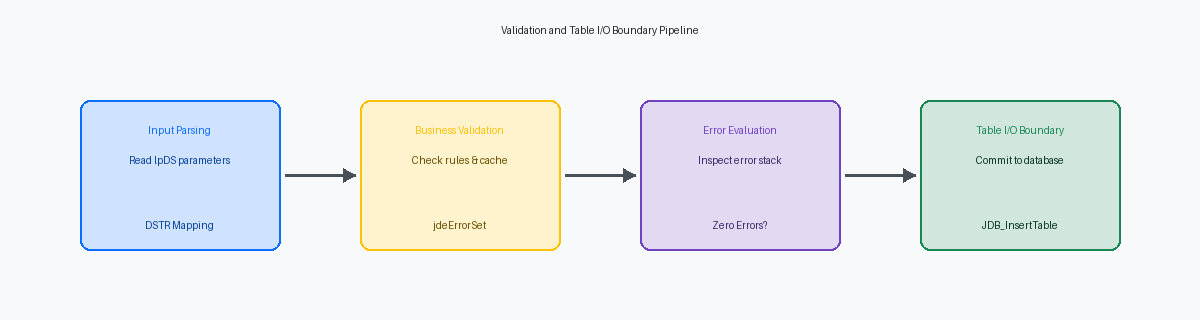
In Form Design Aid (FDA)The JD Edwards tool used to create and modify interactive applications and their logic., dropping a business functionA reusable piece of code (C or NER) that performs specific business logic or database tasks. like F4211FSEditLine (B4200310) into an event ruleJDE's proprietary scripting language used to add logic to applications and reports. and assuming the HTML engine will gracefully catch a processing failure is a high-risk mistake. A significant portion of custom interactive applications (P55/P56) we audit, in our experience around a third to half, suffer from silent failures because developers rely on the JDE runtimeThe environment that executes JDE applications and manages their behavior during user interaction. to bubble up errors automatically. This article provides a concrete JDE APPL example call business function from event rules to demonstrate how to prevent these hidden database corruptions.

- Details
- By Vincenzo Caserta
- Category: APPL Development
A significant portion of custom interactive application (APPL) defects audited during 9.2 upgrades—in our experience, around a third to half—stem from classic JDE APPL event sequence mistakes developers make when assuming synchronous execution. The root cause is rarely a broken business function (BSFN); it is a failure to account for how the JAS (Java Application Server) engine serializes events. When developers misplace Event Rules (ER) within Form Design Aid (FDA), they expose applications to race conditions that only manifest when network latency and JVM garbage collection distort execution timing.
- Details
- By Vincenzo Caserta
- Category: APPL Development
When auditing custom P55 applications, I regularly find Headerless Detail forms with thousands of lines of procedural Event Rules (ER) crammed directly into the OK button. This architectural anti-pattern degrades interactive runtime performance on the HTML server and turns minor Tools Release upgrades into multi-week debugging marathons.

- Details
- By Vincenzo Caserta
- Category: APPL Development
In a typical custom estate of 5,000 to 15,000 objects, poorly architected Interactive Applications (APPLs)Interactive programs in JD Edwards used by end-users to view and manipulate data through a graphical interface. account for a substantial portion of post-upgrade retrofitting and hotfixes, often exceeding half of the total effort. Form Design Aid (FDA)The development tool within JD Edwards used to create and modify interactive application forms and their logic. makes drag-and-drop layout so simple that developers routinely dump complex business logic directly into control events, creating monolithic forms that choke during 64-bit runtimeA computing environment that processes data in 64-bit chunks, allowing for much larger memory usage and improved performance. migrations or Tools ReleaseA software update from Oracle that provides new technical features and system improvements for the JD Edwards platform. 9.2.8 upgrades. This structural debt is entirely preventable if you enforce strict JDE APPL development best practices for custom forms within your engineering team.
More Articles …
Page 3 of 6