Select your language



- Details
-
 By Vincenzo Caserta
 - Category: APPL Development
Over two decades spent auditing JDEJD Edwards, an Enterprise Resource Planning (ERP) software suite from Oracle used to manage business operations. codebases reveals a common pattern: custom interactive applications (APPLAn interactive application in JD Edwards that provides a user interface for viewing or entering data.) with hundreds of lines of complex validation logic crammed directly into a single "OK" or custom button's Button Clicked event. This is an architectural dead end. When you upgrade to Tools Release 9.2.8A specific version of the JD Edwards technical foundation that provides the underlying functionality for the ERP. or attempt to expose that logic to OrchestratorA JD Edwards tool used to automate business processes and integrate the ERP with external systems and IoT devices., you realize you have trapped your business rules inside the presentation layer, forcing expensive retrofits.

- Details
- By Vincenzo Caserta
- Category: APPL Development
When a custom interactive application (APPLAn interactive application in JD Edwards used by end-users to view, enter, or modify data.) in JDE EnterpriseOne 9.2 takes several seconds to load a grid, developers often blame database hardware or network latency. In the vast majority of cases, the culprit is a poorly constructed join in a custom Business View (BSVW)A selection of columns from one or more tables that provides data to a JD Edwards application. defined in Form Design Aid (FDA)The development tool used to create and modify the user interface of JD Edwards applications.. Mastering JDE APPL custom business view usage to avoid bad joins is critical to prevent the database from performing runaway nested loopsA database join method where the system scans one table repeatedly for every row found in another table. over millions of rows in tables like F0911The General Ledger Post table, which stores all accounting transaction details in JD Edwards. or F4211.

- Details
- By Vincenzo Caserta
- Category: APPL Development
Promoting interactive applications (APPLA JD Edwards Interactive Application used to create user interfaces for data entry and retrieval.) based solely on "happy path" functional testing is a direct route to production instability. When a business analyst signs off on an APPL because they successfully processed a handful of test transactions, they miss the latent memory leaks, unmapped Data Structures, and unreleased table locks lurking in the Event RulesThe proprietary scripting language used within JD Edwards to define the logic and behavior of applications and reports.. In EnterpriseOne 9.2The current major release of Oracle's JD Edwards ERP software suite., a single unreleased database handle or an improperly closed business functionA reusable module of C or Java code that performs specific business logic or database operations. call in a custom APPL can degrade HTML serverThe web server component that renders the JD Edwards interface for end-users. performance for hundreds of concurrent users, transforming a minor deployment into an emergency Sev-1 rollback.

- Details
- By Vincenzo Caserta
- Category: APPL Development
Applying an Oracle ESUElectronic Software Update; a package of fixes or enhancements released by Oracle for JD Edwards software. to a heavily modified core application like Sales Order Entry (P4210The JD Edwards application identifier for the Sales Order Entry program.) or Requisition Entry (P4312) is where upgrade timelines frequently derail. While tools like ER CompareA JD Edwards utility used to compare and merge Event Rules between different versions of an object. have existed for decades, developers still routinely corrupt local specsShort for specifications; the metadata definitions that describe how JD Edwards objects look and behave. or drop critical business logic because they treat the merge as a mechanical copy-paste exercise. In a typical 9.1 to 9.2 upgrade, interactive applications (APPLsInteractive Applications in JD Edwards that provide the user interface for viewing and entering data.) represent a relatively small portion of the modified object footprint, typically around 10% to 20%, yet they account for over a third of post-go-live defect reports due to poorly executed manual merges.
- Details
- By Vincenzo Caserta
- Category: APPL Development
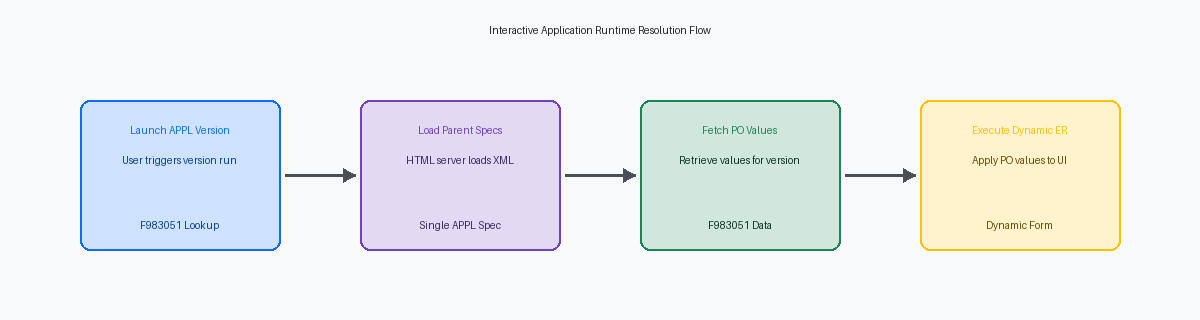
In over two decades of rescuing custom JDEJD Edwards, a comprehensive Enterprise Resource Planning (ERP) software suite. codebases, the most persistent architectural failure I see is treating Interactive Application (APPL)A JD Edwards program with a user interface for viewing or entering data. versions like Batch Application (UBE)A JD Edwards background process used for reports or bulk data processing. versions. While a UBE version contains independent data selection and sequencing specs, an APPL version is simply a pointer to Processing OptionUser-defined parameters that control how a program behaves without changing its code. values stored in the F983051The central database table in JD Edwards that stores version definitions and parameters. table. Misunderstanding this distinction leads to developers hardcoding version names inside Event RulesThe proprietary scripting language used to program logic within JD Edwards objects., which forks the codebase and inflates your upgrade footprint.
More Articles …
Page 5 of 6