Select your language


My Blog

- Details
-
 By Vincenzo Caserta
 - Category: My Blog
The Shift from Automation to Stochastic Autonomy
A modular chemical processing plant in Rotterdam recently averted a catastrophic pressure failure by autonomously re-routing thermal flow through a secondary cooling loop that had not been previously designated for that specific emergency protocol. This wasn't a pre-programmed 'if-then' response; it was the result of a high-fidelity 'World Model' predicting a 98.4% probability of container breach within twelve seconds. This distinction marks the fundamental transition we have witnessed leading into 2026: the move from automated systems to truly autonomous decision-making engines.

- Details
- By Vincenzo Caserta
- Category: My Blog
Neurom-based systems have officially crossed the 10-peta-spike per second threshold while operating on less than 15 watts of power, marking the most significant shift in computational efficiency since the invention of the transistor. This breakthrough represents the culmination of years of research into neuromorphic engineering, moving us away from the rigid constraints of traditional silicon logic and toward a fluid, biological approach to data processing.
- Details
- By Vincenzo Caserta
- Category: My Blog
The Dawn of the Post-Quantum Era
As we navigate the technological landscape of 2026, the arrival of functionally relevant quantum computers is no longer a distant theoretical concern. For decades, our global digital infrastructure has relied on public-key cryptography—specifically RSA and Elliptic Curve Cryptography (ECC)—to secure everything from bank transactions to private messaging. However, the advancement of quantum processors has necessitated a transition to what we call Post-Quantum Cryptography (PQC).
- Details
- By Vincenzo Caserta
- Category: My Blog
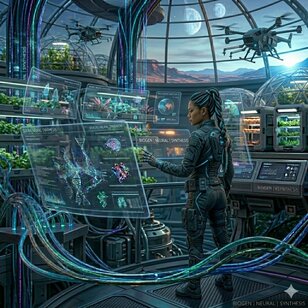
The Shift from Traditional Logic to Neuromorphic Systems
As we navigate the technological landscape of 2026, the term "Neurom" has become synonymous with the most significant shift in computing architecture since the mid-20th century. For decades, we relied on the Von Neumann architecture, where the processing unit and memory are physically separated. While this served us well during the rise of the internet and early AI, the massive computational demands of modern Large Language Models (LLMs) have pushed this design to its thermal and energetic limits. Enter Neuromorphic Computing.
More Articles …
Page 10 of 18